 ANABIOTICA
Creatine Monohydrate: Proven Uses and New Research
Strong evidence supports high-intensity performance and resistance training. Brain, cognition, stress, and sleep-loss claims need a more careful reading.
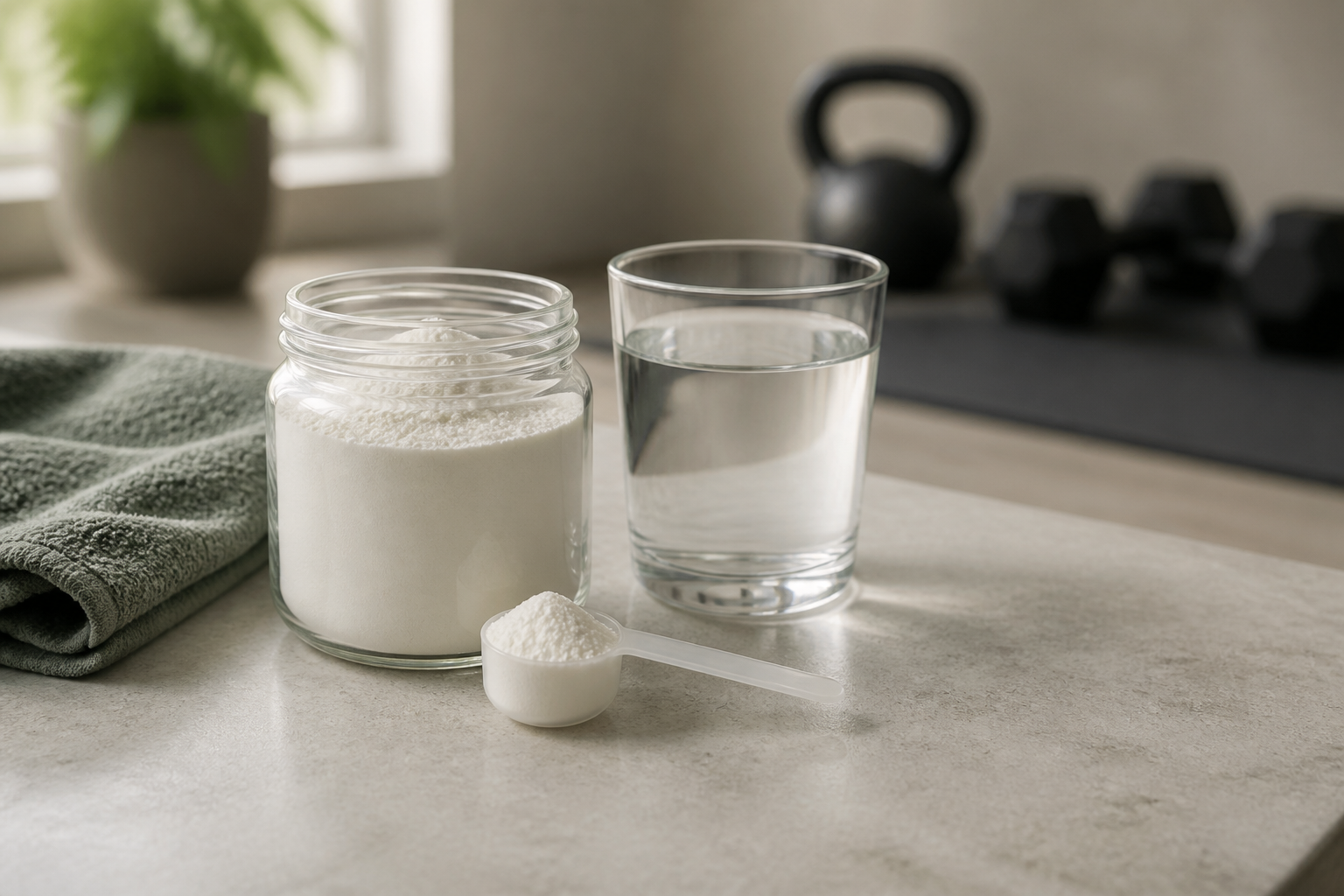
Creatine monohydrate sits in an unusual position among supplements: its main benefits are well established, while some of its most interesting proposed uses are still uncertain. It reliably increases the capacity for repeated, high-intensity effort and can modestly improve strength and lean-mass gains when paired with resistance training. It has also been studied extensively enough that typical use is well tolerated in healthy adults. Those conclusions do not automatically extend to sharper thinking, resilience to stress, or protection from lost sleep. (NIH Office of Dietary Supplements; Desai et al., 2024)
The brain research is worth following because the mechanism is plausible and several human experiments are encouraging. But the current record is mixed: a large trial found, at most, a small cognitive effect; a critical systematic review found equivocal results; and the European Food Safety Authority concluded that a general cause-and-effect claim for improved cognition had not been established. (Sandkühler et al., 2023; McMorris et al., 2024; EFSA NDA Panel, 2024)
What the Evidence Shows
| Claim | Current judgment | Why |
|---|---|---|
| Better repeated high-intensity exercise performance | Established | Numerous controlled trials consistently support strength, power, and repeated maximal-effort work; benefits vary between people. |
| Greater gains from resistance training | Established, modest | Meta-analyses find additional strength and lean-mass gains, but some lean-mass change includes water. |
| Better cognition in healthy, well-rested adults | Insufficient | Results differ by test and study; regulators have not accepted a general cognitive benefit. |
| Better cognition during sleep deprivation | Emerging | Small trials show signals, including faster processing, but use protocols too limited or intensive for routine advice. |
| Less everyday psychological stress | Not established | “Stress” in this literature usually means sleep loss, hypoxia, demanding tasks, ageing, or disease—not relief of ordinary emotional stress. |
This distinction matters. A convincing biological explanation is not the same as a demonstrated benefit, and a result under severe sleep loss is not evidence that everyone will think better after a daily scoop. (McMorris et al., 2024)
Performance Benefits
Creatine is made by the body and obtained in smaller amounts from foods such as meat and fish. Most of it is stored in skeletal muscle as creatine and phosphocreatine. That system helps regenerate adenosine triphosphate (ATP), the immediate energy currency used during brief, hard efforts. Supplementation expands muscle creatine stores; it does not act like a stimulant and does not build muscle without a training stimulus. (NIH Office of Dietary Supplements)
The clearest payoff is therefore not unlimited energy or endurance. It is a small increase in the work a person can perform across repeated sprints, lifts, or other maximal efforts with short recovery periods. Over weeks, that extra training capacity can accumulate into better adaptation. The NIH review describes little value for endurance activity, while a 2024 meta-analysis in adults under 50 found that creatine plus resistance training produced larger maximal-strength gains than training with placebo. (NIH Office of Dietary Supplements; Wang et al., 2024)
Body-composition results need careful wording. A 2024 systematic review found more lean body mass with creatine plus resistance training than with training alone. Creatine also draws water into muscle, particularly early in use, so “lean mass” is not identical to newly built muscle tissue. Direct imaging studies still suggest a small added hypertrophy effect, but the supplement remains an aid to training rather than a substitute for it. (Desai et al., 2024; Burke et al., 2023)
Creatine in the Brain
Brain cells also use the creatine–phosphocreatine system to buffer energy demand. Oral supplementation can increase brain creatine, but usually less readily than it increases muscle stores. That makes a benefit biologically possible, particularly when energy demand is unusually high. It does not prove that more stored creatine produces a noticeable improvement in memory, attention, or reasoning. (McMorris et al., 2024)
The strongest single test of routine supplementation enrolled 123 adults, roughly half vegetarian and half omnivorous, in a preregistered double-blind crossover trial. Six weeks of 5 g/day produced evidence compatible with a small benefit, but the primary analyses were not conventionally statistically significant, exploratory outcomes were mixed, and gastrointestinal side effects were reported more often during creatine use. The study did not show a large, dependable “nootropic” effect. (Sandkühler et al., 2023)
Reviews point in different directions. One meta-analysis reported small improvements in memory, attention time, and processing-speed measures, but it combined heterogeneous populations and tests. A separate 2024 systematic review judged cognitive results equivocal and highlighted inconsistent dosing, weak study designs, and too little measurement of whether brain creatine actually changed. EFSA reviewed 23 intervention studies and concluded that the evidence did not establish improved cognitive function in the general healthy adult population. (Xu et al., 2024; McMorris et al., 2024; EFSA NDA Panel, 2024)
Sleep Loss as a Stress Test
The emerging case is more specific: creatine might help preserve some cognitive performance when brain energy demand is strained. An older randomized trial in 20 young men reported a benefit on one executive task after 36 hours without sleep, exercise, and several days of loading, but not a broad rescue across every measure. That is a clue, not a general treatment result. (McMorris et al., 2006)
In 2024, a double-blind crossover experiment gave 15 healthy young adults a single dose of 0.35 g/kg—about 25 g for a 70 kg person—during 21 hours of sleep deprivation. Compared with placebo, creatine altered brain energy metabolites measured by magnetic resonance spectroscopy and improved several memory and processing-speed outcomes over the test night. The trial was elegant but very small, measured one laboratory night, and used a dose far above the usual 3–5 g/day maintenance range. It cannot establish that high acute doses are safe or useful for shift workers, chronic insomnia, travel, or repeated sleep loss. (Gordji-Nejad et al., 2024)
A 2026 systematic review located only five eligible sleep-deprivation studies and described the overall direction as favorable but sparse and dependent on the cognitive domain measured. That is the right interpretation today: a promising research signal, not a reason to replace sleep, caffeine guidance, fatigue controls, or medical care with creatine. (Williams et al., 2026)
“Stress benefit” should not be stretched beyond these models. Mental fatigue, low oxygen, ageing, illness, and sleep deprivation impose different physiological demands. There is not yet good evidence that creatine reduces everyday anxiety, lowers perceived psychological stress, improves mood in the general population, or makes normal work pressure easier to tolerate. (McMorris et al., 2024; EFSA NDA Panel, 2024)
Use and Safety
Creatine monohydrate is the form to which nearly all of this evidence applies. A common maintenance protocol is 3–5 g/day. Loading—often 20 g/day divided into four doses for five to seven days—fills muscle stores faster, but it is optional; 3–6 g/day can reach a similar endpoint more gradually over about three to four weeks. More expensive forms have not demonstrated superior absorption, effectiveness, or safety. (NIH Office of Dietary Supplements; Australian Institute of Sport)
The most predictable effects are an early rise in body mass from increased water retention and, in some people, gastrointestinal discomfort—especially with large single doses. Dividing a loading dose, taking it with meals, or skipping loading can reduce practical discomfort. Weight gain may be unwanted in weight-category or body-weight-supported sports even when it is not harmful. (Australian Institute of Sport)
Kidney fears deserve nuance. A 2025 systematic review found a small rise in serum creatinine but no significant reduction in measured or estimated filtration across the included studies. Creatinine is both a breakdown product related to creatine and a marker used to estimate kidney function, so supplementation can complicate interpretation of a blood test without proving kidney damage. A clinician interpreting kidney tests should know about creatine use. The evidence is reassuring for studied doses and durations in healthy adults; it is not a safety guarantee for people with kidney disease or for unmonitored high-dose use. (Naeini et al., 2025)
People with kidney disease, pregnancy or breastfeeding, significant medical conditions, or medicines that affect kidney function should discuss supplementation with a qualified clinician. Product quality is a separate risk: a single-ingredient, independently tested creatine monohydrate product avoids the uncertainty of proprietary multi-ingredient blends. (NIH Office of Dietary Supplements)
How Strong Is the Evidence?
| Dimension | Exercise and training | Brain and sleep loss |
|---|---|---|
| Clinical relevance | High. Performance and training outcomes are directly measurable and useful. | Low to emerging. Most outcomes are short laboratory tests, not durable everyday benefits or prevention of cognitive decline. |
| Study quality | High. Many controlled trials and meta-analyses support the core physical benefits. | Low to moderate. Studies are heterogeneous, often small, and weakly replicated. |
| Safety data | High for typical use in healthy adults. Common effects and medium-to-long-term tolerability are well described. | Limited for experimental protocols. Special populations and repeated acute high doses need more evidence. |
Overall, confidence is high that creatine improves repeated high-intensity exercise capacity and modestly supports resistance-training gains. Evidence for general cognitive enhancement is insufficient. Preserving some performance during acute sleep deprivation remains an emerging possibility. (NIH Office of Dietary Supplements; EFSA NDA Panel, 2024; Williams et al., 2026)
Bottom Line
Creatine monohydrate earns its reputation when the claim stays narrow: it can help healthy adults perform a little more repeated high-intensity work and can add modestly to the results of resistance training. Typical maintenance use is well studied and generally well tolerated, with water-related weight gain and gastrointestinal discomfort as the main practical drawbacks. (NIH Office of Dietary Supplements)
Its brain story is not imaginary, but it is unfinished. Small benefits may exist for particular people, tests, or metabolically stressful situations—especially acute sleep deprivation. Current evidence does not justify presenting creatine as a general cognitive enhancer, stress remedy, or substitute for sleep. (EFSA NDA Panel, 2024; Williams et al., 2026)
Sources
- NIH Office of Dietary Supplements — Dietary Supplements for Exercise and Athletic Performance
- Australian Institute of Sport — Creatine: how and when to use it
- Australian Institute of Sport — Creatine: concerns and considerations
- Desai et al. (2024) — Resistance training-based changes to body composition
- Wang et al. (2024) — Resistance training and muscle strength gains
- Burke et al. (2023) — Regional measures of muscle hypertrophy
- Sandkühler et al. (2023) — Randomized trial of cognitive performance
- Xu et al. (2024) — Systematic review and meta-analysis of cognition
- McMorris et al. (2024) — Critical systematic review of cognition
- EFSA NDA Panel (2024) — Creatine and improvement in cognitive function
- McMorris et al. (2006) — Sleep deprivation, cortisol, melatonin, and behavior
- Gordji-Nejad et al. (2024) — Single-dose creatine during sleep deprivation
- Williams et al. (2026) — Systematic review of acute sleep deprivation
- Naeini et al. (2025) — Systematic review and meta-analysis of kidney function